

Every acquisition conversation eventually arrives at the same question: what is this business worth? For a Canadian buyer looking at a Mexican target, that question has a second layer most domestic playbooks don’t address.
A valuation method that works cleanly in Toronto or Calgary doesn’t translate automatically across the border — not because the math changes, but because the inputs do: the reliability of the financials, the discount rate, the tax treatment of the gain, and increasingly, the regulatory chronometer the deal has to beat. This article builds on the sources consulted and referred to below, and adapts them for the specific mechanics of buying a business in Mexico as a Canadian.
I. Start With the Three Approaches — They Still Apply
The three valuation approaches, and where each one strains across the border
Income-based
DCF
Market-based
Multiples
This is the approach that carries the most weight when a business has real earnings history and reasonably predictable growth, which describes most established Mexican SMEs. A comprehensive valuation typically blends more than one, and it is worth noting that a valuator won’t hand you a single number — they hand you a range, usually wider for smaller companies and for sectors like technology where forecasts are less certain.
Sale price is not the same thing as value. Price is what changes hands; value is what an arm’s-length, informed buyer and seller would agree to under no compulsion. The two diverge for reasons that matter even more in a cross-border deal — a strategic buyer’s synergies, a seller’s urgency, and how much of the price is cash versus an earnout or a vendor note.
PERSONAL NOTE FROM THE AUTHOR
II. What Makes a Mexican Valuation Different
Quality of earnings gets more scrutiny, not less
The succession numbers explain why so much of this inventory is coming to market
4%
~50%
46%
78%
74%
85–95%
A growth premium is now attached to geography, not just sector
III. The Discount Rate Has a Country-Risk Layer Baked In
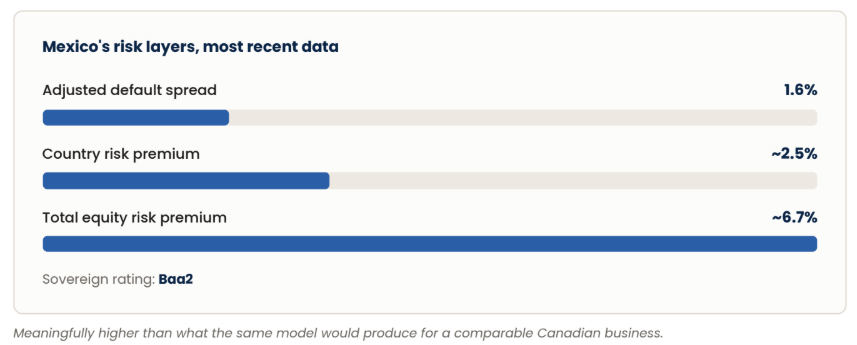
That difference alone can move an EBITDA multiple by a full turn or more, which is exactly why applying a Canadian or US comparable multiple to a Mexican target without adjustment overstates value. A buyer walking into a negotiation with an unadjusted number is negotiating from a position that won’t survive their own lenders’ or advisors’ scrutiny.
IV. Tax Treatment Isn't a Footnote — It Changes What "Value" Means to Each Side
Treaty withholding rates
The capital gains election
Two regimes for a non-resident seller of shares
Rate and base
25% withholding on the gross sale price, no deductions permitted
35% on the net gain
When it wins
When the cost basis is very low relative to the sale price
Very often the better outcome once acquisition cost is meaningfully high
Conditions
None — it is the fallback
Appoint a Mexican legal representative who takes on
joint liability for any shortfall; that representative must demonstrate financial solvency; the gain must be
documented in a report from a Mexican-registered
public accountant
THIS IS NOT OPTIONAL PAPERWORK
V. A Regulatory Clock Is Now Part of the Valuation Conversation
One development specific to right now: Mexico’s government has sent Congress a reform to the Foreign Investment Law that would require prior approval from the National Foreign Investment Commission for any foreign acquisition exceeding 49% ownership in companies operating in defined strategic sectors — energy, mining, telecommunications, semiconductors, data infrastructure, healthcare, transportation, aerospace and defense among them.
The bill was still sitting in Senate committee as of early September 2026, with the asset threshold that triggers the review left to be set by regulation after passage, and a 60-business-day review clock once it applies.
This doesn’t affect most mid-market acquisitions outside those sectors. But for any Canadian buyer eyeing a majority stake in a business that could plausibly be read into one of those categories, the sensible move is to treat the current, simpler approval environment as having a shelf life, and to price that timing risk into the deal — either by moving to close before the regime takes effect, or by building the closing timeline and valuation around the possibility of an extra approval layer.
VI. Why This Is the Moment to Be Doing This Math
Put the pieces together and the opportunity is stark. Mexico’s M&A market grew 17% year-over-year in the first half of 2026, to US$11.6 billion, and deal flow remains dominated by US-linked capital. Canadian buyers are a small fraction of that activity despite Canada’s proximity, its trade relationship with Mexico, and a tax treaty that already favours structured cross-border ownership.
At the same time, the succession numbers above mean a very large inventory of fundamentally sound, family-owned businesses will change hands over the next decade — largely because their owners have no internal succession plan, not because the businesses are underperforming.
That combination of real assets, thin succession planning, and comparatively little Canadian competition for these deals is precisely the environment where a disciplined, properly adjusted valuation is worth the most. It is the difference between paying a fair, well-supported price for a business with a real growth premium ahead of it, and either overpaying because an unadjusted multiple looked reasonable, or walking away from a good business because an unadjusted discount rate made it look expensive.
WHAT ACTUALLY CHANGES ON THE CHECKLIST
VII. Sources
- BDC — Business Valuation: A Guide for Entrepreneurs
- Why Company Valuation Demands More Than an EBITDA Multiple — Mexico Business News
- Succession: The Blind Spot of Many Family Businesses in Mexico — Mexico Business News
- ETA and Search Funds: The Future of Business Succession in Mexico — Mexico Business News
- Damodaran — Country Default Spreads and Risk Premiums
- PwC — Mexico Corporate Withholding Taxes
- Foreign Resident Capital Gains Taxation in Mexico: A Practical Guide — International Tax Review
- Mexico M&A Volume Rises 17% YoY in 1H26 to US$11.6 Billion — Mexico Business News
- Mexico: M&A Market Overview & 2026 Outlook — FCap Advisors
- Baker McKenzie — Mexico Foreign Investment Proposal on National Security